20 Arabesque Vector Patterns: Design Assets for Cultural Projects
Working with the 20 Arabesque Vector Patterns is less like picking a font and more like acquiring a piece of history. When you first open the files, the complexity is immediately apparent. These aren't just simple shapes; they are intricate webworks of geometry and flora, deeply rooted in Islamic art tradition. You see the interlacing lines that mimic the tilework of historic mosques and the kind of symmetry that makes a designer’s heart beat a little faster. As someone who has spent years curating brand identity kits, I find that these patterns offer a specific kind of visual weight. They feel substantial. They don't just sit on the page; they demand attention through their density and repetition. For anyone looking to add a layer of sophistication to their work, this collection provides the necessary architectural foundation.
Visualizing the Geometry: What Makes This Set Unique
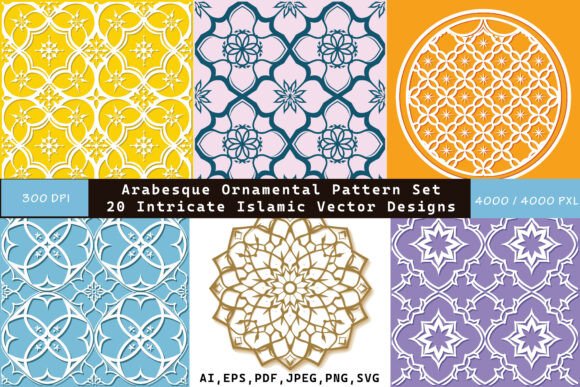
The true strength of this collection lies in its versatility between seamless and non-seamless motifs. We often talk about modern typography as being the hero of a design, but sometimes a project needs a background that carries the narrative. The 20 Arabesque Vector Patterns are built on a foundation of mathematical precision. You have the classic floral latticework that feels organic and soft, alongside the harder, more rigid geometric grids found in traditional mosque geometry. This duality is crucial. It allows you to use the same design set for a soft, elegant wedding invitation and a strong, architectural brand presentation.
From a technical standpoint, the 300 DPI resolution is a non-negotiable feature for professional work. I have seen too many projects ruined by pixelation when scaling decorative elements for print. With these files provided at 4000 × 4000 pixels, you have room to breathe. You can crop into a specific section of a pattern for a detail shot or scale it up for large-format packaging design without losing that sharp, professional edge. The visual personality here is one of luxury and timelessness. It avoids the fleeting trends of flat design, opting instead for depth and texture that holds up over time.
Strategic Applications: From Branding to Digital Backgrounds
Knowing where to deploy these patterns is just as important as the patterns themselves. In the realm of branding, this collection is a secret weapon for businesses wanting to convey heritage, quality, and attention to detail. I recently worked with a client in the gourmet food sector who needed to reposition their product as "premium." We utilized one of the geometric vector patterns as a subtle texture on their packaging design. It didn't overpower the typography, but it added a tactile feel that communicated value instantly. It transformed a standard box into something that felt like a gift.
Beyond physical products, the digital space is where these patterns truly shine. For social media graphics, consistency is key. Using a specific motif from the 20 Arabesque Vector Patterns as a recurring background element can tie a campaign together. Think about Ramadan or Eid marketing campaigns; the cultural resonance of these designs provides immediate context and celebration. However, don't limit yourself to religious observances. These designs work beautifully for editorial design, particularly in magazine headers or pull quotes where you want to evoke a sense of the Middle East or luxury travel. They serve as excellent design assets for creating immersive digital environments.
Technical Integration and Pairing Strategies
As a creative professional, you need to think about how these ornamental patterns interact with your typeface choices. Because the patterns are visually "busy" with intricate details, they require a font pairing that offers balance. If you overlay text directly onto these designs, you risk visual chaos. My recommendation is to use a strong, clean sans serif font for body text. The geometric simplicity of a sans serif provides a necessary counterpoint to the ornate curves of the arabesque. For headlines, a serif font with high contrast can look stunning, bridging the gap between traditional elegance and modern readability.
There is also the question of negative space. You don't always have to use the full pattern. One of the advantages of having these in vector formats like AI and EPS is the ability to edit the artwork. You can isolate a single medallion or create a border strip. This flexibility is vital for logo design and packaging design, where the pattern needs to fit specific die-lines or brand marks. When testing these patterns in your workflow, pay close attention to the opacity. Lowering the opacity of the pattern to 10-15% can create a sophisticated watermark effect that adds texture to a web design background without making the text unreadable.
Practical Considerations for Workflow and Licensing
When you integrate a new asset library into your workflow, ease of use matters. The inclusion of SVG and PNG formats alongside the standard vector files means this set is ready for both print and digital environments immediately. For those working in web design, SVGs are essential for fast loading times and scalability across different screen resolutions. If you are a crafter or working on physical stationery, the high-res JPEGs and PDFs ensure that your prints—whether for journals, planners, or scrapbooks—come out crisp.
It is also worth noting the importance of understanding the licensing for such commercial fonts and assets. While the prompt mentions contacting the creator for download issues, always verify the commercial usage rights for your specific project scope. Usually, assets like these allow for print-on-demand or physical end products, but it is best practice to ensure your brand identity project is legally covered. The 20 Arabesque Vector Patterns are more than just decoration; they are functional tools. When used correctly, they elevate a project from amateur to professional, providing a cultural richness that generic stock art simply cannot match. Whether you are designing for a luxury brand or creating a personal DIY project, these patterns offer a bridge between traditional artistry and contemporary design needs.